

sms
Business Texting From the Customer's Side of the Phone
Most advice about business texting is written from the sender’s chair: open rates, campaign calendars, registration paperwork. This post sits in the other chair, the one belonging to the person whose phone buzzes. What they think of your message decides whether texting builds a relationship or wears one down.
Why the call goes unanswered and the text gets read
Section titled “Why the call goes unanswered and the text gets read”Watch someone get a call from a number they don’t recognize. They glance at it, decide it’s probably a robocall, a scam, or a sales pitch, and let it ring out. That reflex is learned. Years of spoofed caller ID and “your car’s extended warranty” calls have taught people that an unknown number usually wants something from them, right now, on its schedule.
A phone call is also expensive for the person receiving it. It demands their full attention at that moment, whether they’re in a meeting, driving, or putting a kid to bed. Even a welcome call from their dentist interrupts something.
A text works differently on every one of those points:
- It can wait. The customer reads it when they’re free, not when you happen to dial.
- They can see what it is before deciding. The preview shows who is texting and roughly why. There’s no gamble involved in looking.
- It leaves a record. The appointment time, the address and the reference number stay in the thread. Nobody has to scramble for a pen.
- Replying takes seconds. “C” to confirm, a quick “running 10 min late”, a photo of the broken part.
None of this means calls are obsolete. Some conversations deserve a voice. Our tongue-in-cheek calls vs. texts showdown makes the case for when each one fits. But for the short, practical updates that make up most business-customer contact, a text respects the customer’s time in a way a cold call can’t.
The text thread is personal territory
Section titled “The text thread is personal territory”There’s a catch. A business text lands in the same app as messages from the customer’s partner, their mother, and their group chat. That’s why it gets read, and it’s also why mistakes cost so much more here than in email. A pushy email gets filed under Promotions. A pushy text feels like someone walked into the customer’s living room.
So the question to ask about any message isn’t “will this get opened?” It’s “would this customer be glad they got it?”
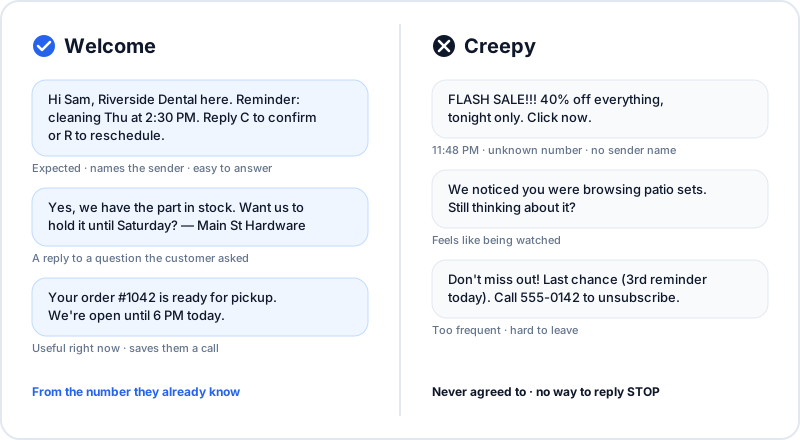
What customers find welcome
Section titled “What customers find welcome”Across industries, the texts people actually appreciate have a few things in common.
They expected it. The customer booked the appointment, placed the order, or asked a question. The text continues something they started.
It’s useful in the moment. Reminders, “your table is ready”, “the technician is 20 minutes out”, “your prescription can be picked up”. These save the customer a phone call of their own.
It’s clear who sent it. A message that opens with your business name, or ends with a short signature, doesn’t make anyone wonder whether it’s a phishing attempt.
It can be answered. The best business texts are conversations, not broadcasts. When the customer replies “can we do Thursday instead?”, a person should see that reply and answer it. A no-reply number that ignores responses throws away the main reason texting works.
It comes from a number they recognize. If the customer has called your main line for years, a text from that same number feels familiar. A text from a random new number starts out under suspicion.
What reads as creepy (or just rude)
Section titled “What reads as creepy (or just rude)”The other column is just as consistent.
Surprise subscriptions. The customer gave you their number for a delivery update and now gets weekly promotions. In their eyes that’s a broken promise, and in many cases it’s a legal problem too.
Showing what you know about them. “We noticed you were looking at…” works in a retargeting ad because it’s anonymous. In a direct text it feels like surveillance.
Bad timing. A promotional text at 11:45 PM or 6 AM tells the customer you care more about your send schedule than their sleep.
Volume. One useful message is a service. The third promotion of the day is harassment.
Making it hard to leave. If “STOP” doesn’t work, or the customer has to call in to unsubscribe, they won’t. They’ll block you, report you as spam, and remember.
Pretending to be a person when you aren’t, or the reverse: a bot that can’t recognize “cancel my appointment” as a real request rather than a keyword.
Consent is the customer experience
Section titled “Consent is the customer experience”It’s tempting to treat consent as a compliance box: get the checkbox, store the timestamp, move on. (If you want the legal side, our CASL guide covers what Canadian law requires.) But look at it from the customer’s side and consent is the experience. Every welcome item above is something the customer agreed to or started. Every creepy item is something they didn’t.
In practice, a consent-first texting program comes down to a few habits:
- Ask clearly, at a natural moment. At booking, at checkout, on a signup form. Say what you’ll send and how often.
- Keep different promises separate. Agreeing to appointment reminders isn’t agreeing to marketing.
- Make leaving easy and final. One word, honoured immediately, with no “are you sure?” follow-up campaign.
- Stay inside the hours your customers are awake.
- Answer replies. A customer who texts back is handing you a conversation. Don’t let it disappear into a void.
How Flare is built around the customer’s side
Section titled “How Flare is built around the customer’s side”We designed Flare, SIPSTACK’s business texting product, so the customer-friendly path is the default rather than something you have to configure:
- Text from your business number. Customers see the number they already know. You can use a new local or toll-free number or port your existing line.
- A shared inbox for replies. Conversations live in one inbox your team works from in Switchboard, and Pulse users see the same threads on their phones, so a reply isn’t stuck on whoever happened to send the first message. On the Ultra plan, reply routing can assign incoming replies to the right person by keyword.
- Opt-outs that always work. STOP, UNSUBSCRIBE and their French equivalents are recognized automatically and can’t be turned off. After one confirmation, nothing more goes to that number (no campaign, no auto-reply, no manual message) until the customer texts START. Words like CANCEL count only when they’re the whole message, so “cancel my appointment” reaches your team as the request it is.
- Consent checked at send time. Campaigns skip contacts without the right consent on record. That includes US numbers without express consent, which are always skipped.
- Sensible hours and frequency. Campaign messages never go out before 9 AM or after 8 PM in the recipient’s local time, and nobody gets more than three campaign or drip messages in 24 hours.
- An identifiable sender. An optional business signature can be added to outbound messages, and a HELP reply tells the customer who you are and how to reach you.
None of this will write a good message for you. But it does mean that a rushed afternoon or a new hire won’t turn into a 6 AM promotional blast to people who asked you to stop.
The test worth running
Section titled “The test worth running”Before you send anything, picture the text arriving on your own phone, from a business you like, at the moment it would actually be delivered. If you’d be glad to get it, send it. If you’d be annoyed, the customer will be too, and unlike email, a text gives them a one-word way to tell you.